Scholarship

AI Law And Society at Clemson

I’ll be presenting a keynote lecture at Clemson University’s Law and Society Symposium next week. The Symposium is organized around legal and philosophical questions raised by Artificial Intelligence (AI). My keynote is entitled “What Is Intelligence For?” This area moves quickly, but a tentative abstract of my remarks is as follows:

Artificial intelligence technologies are today capable of generating artifacts comparable to those we would previously have expected could only be produced through the skilled intellectual labor of human beings, from college essays to mathematical proofs to legal briefs to pop music. Our society is currently divided as to whether and in what circumstances they should be permitted to do so, and how if at all they might be prevented from doing so. The reasons generally given for opposition to artificial intelligence—concerns over the allegedly poor quality of AI-generated artifacts, concerns about labor competition, concerns about misappropriation of the labor that went into producing the materials AI systems have been trained on—are well rehearsed. I wish to focus on a different question: why we do, or should, value human intellectual labor. If generative AI technologies provide us with artifacts at least comparable to those produced by such labor (or if they soon shall), and if they do so in a way that fairly compensates the authors of their training data and provides adequate material resources to human beings whose labor-market value has been damaged by the productivity gains of artificial intelligence, would we still have any basis to object to them? I think there are areas where we might, and areas where we might not. The distinction depends on a lesser-invoked but increasingly salient allegation concerning AI technologies: that their use reduces the user’s capacity to engage in intellectual labor. The question that arises in areas like education, mathematics, law, and the arts, is whether we should care if this were indeed the case. In each of these areas, there are arguments that we should, and arguments that we should not. Which of these arguments we find persuasive will turn on what we think human intellectual labor is for—what its purpose or value is—and thus AI technologies thus require us to confront that question directly.

The symposium is free and open to the public, and the full program should be very interesting. Registration is encouraged for those who plan to attend. If you are in the area, I hope I’ll see you there.

New Paper Alert: The Japan Trademarks Dataset

Continuing my series of large datasets on national trademark registration systems, I have just published the Japan Trademarks Dataset on Zenodo. The accompanying paper is forthcoming in the Journal of Law and Empirical Analysis; a preprint draft is available at the Zenodo link.

I recently presented the paper at Stanford Law School at the 26th Annual Intellectual Property Scholars Conference. The slide deck is available here:

My earlier datasets are also available on Zenodo:

“Dividing Trademark Use” at Harvard Law School

On Saturday, October 19, I workshopped my forthcoming paper, Dividing Trademark Use, at the Trademark and Unfair Competition Scholarship Roundtable 2024 at Harvard Law School. The paper, which analyzes the implications for trademark law of the Supreme Court’s two recent decisions in Jack Daniel’s Properties, Inc. v. VIP Products LLC and Abitron Austria GmbH v. Hetronic International, Inc., is forthcoming in the Columbia Journal of Law and the Arts.

New Paper Alert: “Dividing Trademark Use”

I’m happy to announce that my most recent new paper, “Dividing Trademark Use,” will be published in the Columbia Journal of Law and the Arts. The full paper is now available in draft on SSRN. Here’s the abstract:

The trademark law of the United States places special emphasis on whether and how a trademark is used in commerce. But over the long history of the Lanham Act—including some less-than-careful drafting by Congress and some aggressive acts of interpretation by the federal courts—the concept of “use” has become complicated and in many ways confused. Two recent Supreme Court cases—Jack Daniel’s Properties, Inc. v. VIP Products LLC and Abitron Austria GmbH v. Hetronic International, Inc.—reflect and in some ways exacerbate that confusion. But the opinions in these cases also expose an interesting property of “use” in trademark law that has not been deeply examined in the caselaw or the academic literature. That property is that the use of a trademark can be divided among multiple agents with respect to a single product or service. The potential for divided use raises issues of secondary responsibility that trademark law has never comprehensively addressed. This Article catalogues the various notions of “use” in trademark law, shows how Jack Daniel’s and Abitron destabilize these notions, and applies principles of secondary responsibility to attempt to reconcile those cases with other contentious areas of trademark doctrine under the framework of divided use.

Comments welcome.

“A Heap of IP” at IPSC 2024 (Berkeley)

On August 9, 2024, I presented my work-in-progress, “A Heap of IP: Vagueness in the Delineation of Intellectual Property Rights,” at the 2024 Intellectual Property Scholars Conference at Berkeley Law School. The project applies the philosophical literature on vagueness to the problem of uncertainty in the scope of intellectual property rights. The slide deck from the presentation is posted below.

New Paper Alert: An Empirical Evaluation of the Trademark Modernization Act

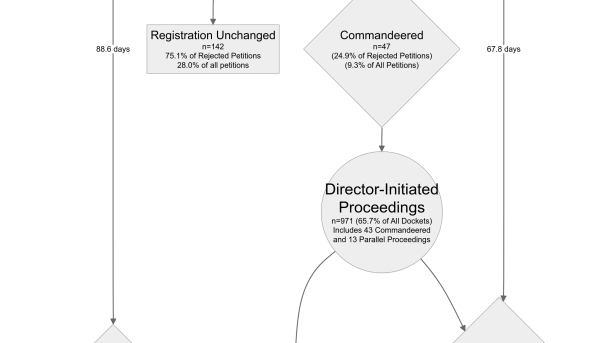
Flow Chart of TMA Petitions

I’ve just posted to SSRN a preprint of my forthcoming article reporting the first empirical analysis of the Trademark Modernization Act’s new ex parte reexamination and expungement proceedings. The paper is accompanied by a new open-access, original dataset on all TMA dockets to date. Here’s the abstract:

The Trademark Modernization Act of 2020 (“TMA”) created two new forms of administrative proceeding designed to clear spurious trademarks from the federal register. Congress’s hope for these new proceedings was that they would “respond to concerns that registrations persist on the trademark register despite a registrant not having made proper use of the mark covered by the registration” by “allow[ing] for more efficient, and less costly and time consuming” means of removing them. This article subjects that policy to empirical examination, disclosing and analyzing a newly constructed dataset covering the dockets of all TMA proceedings (and petitions for proceedings) to date.

The results are not encouraging. Petitions to institute TMA proceedings are seldom filed, proceedings on those petitions are only sometimes instituted, the number of proceedings initiated by the United States Patent and Trademark Office (“USPTO”) sua sponte is relatively small, and the time it takes to progress from institution of a proceeding to a cancellation order is substantial. In a system where random audits of the most recently renewed registrations suggest an overall non-use rate of between 10 and 50 percent, the machinery of third-party petitions (subject to a filing fee) and ex parte review (subject to the USPTO’s overall resource constraints) appear to be a particularly inefficient means of preventing clutter on the trademark register. Based on the analysis presented herein, TMA proceedings seem, at best, to be a fairly reliable and moderately expeditious administrative pathway for clearing previously identified spurious applications from the register, but they are not likely to be a useful tool for combatting at scale the type of bad-faith trademark applications and registrations that have become so common in our age of automated, algorithmic e-commerce.

The paper, which was an invited contribution to the 2024 University of Houston Law Center Institute for Intellectual Property & Information Law National Conference in Santa Fe, is forthcoming in the Houston Law Review and available now in preprint form at SSRN. The dataset is available at Zenodo.

An Empirical Evaluation of the Trademark Modernization Act at Houston/IPIL Santa Fe

This weekend I presented an updated empirical analysis of Trademark Modernization Act expungement and reexamination proceedings at the Annual University of Houston Institute for Intellectual Property and Information Law National Conference in Santa Fe. Many thanks to Professor Greg Vetter for the invitation, and to my co-presenters and other participants for their feedback. The final version of my findings will be published this fall in the Houston Law Review. In the meantime, here is the slide deck from my presentation, with some of the highlights from the paper.

A Heap of IP at Santa Clara (WIPIP 2024)

Today I presented my work in progress, “A Heap of IP: Vagueness in the Delineation of Intellectual Property Rights,” at the Works-in-Progress in Intellectual Property (WIPIP) Conference at Santa Clara University School of Law. This project seeks to connect philosophical literature on vagueness with the intellectual property law literature on claiming. Slides below; comments welcome.

Presentation: Knowledge as a Resource at WIPIP 2023

This past weekend at the 20th Annual Works in Progress in Intellectual Property Colloquium (WIPIP 2023) at Suffolk University in Boston, I presented yet another chunk of my long-running book project, Valuing Progress: A Pluralist Account of Knowledge Governance. This piece, Knowledge as a Resource, examines those characteristics of knowledge–particularly nonrivalrousness–that distinguish knowledge from other goods that are subject to evaluation under the criteria of distributive justice. Because knowledge can be shared without depriving the sharer of anything, norms of distributive justice that have developed in the context of rivalrous goods–norms such as reciprocity–generate paradoxes when we try to apply them to knowledge. This requires us to choose among competing and contestable values underlying and justifying those norms. With respect to reciprocity, for example, it requires us to decide whether reciprocity is grounded in the value of compensation for burdens borne or in the value of gratitude for benefits received. While the distinction between these two justifications can often be ignored for rivalrous goods–particularly where institutions like property rights and markets limit exchange to goods over which parties agree as to their value–it cannot be ignored for knowledge: we must choose one at the expense of the other. The inevitability of such choices among competing values is the overarching theme of the book.

Slides for Knowledge as a Resource can be found here:

New and Improved: The Canada Trademarks Dataset 2.0

Today I released a revised and updated version of the Canada Trademarks Dataset (v.2.0): an open-access, individual-application-level dataset including records of all applications for registered trademarks in Canada since approximately 1980, and of many preserved applications and registrations dating back to the beginning of Canada’s trademark registry in 1865, totaling over 1.9 million application records.

The original dataset, released on March 2, 2021 and described in my article in the Journal of Empirical Legal Studies, was constructed from the historical trademark applications backfile of the Canada Intellectual Property Office, current through October 4, 2019, and comprising 1.6 million application records. The revised dataset represents a substantial advancement over this original dataset. In particular, I have rewritten the code used to construct the dataset, which will now build and maintain a mySQL database as a local repository of the dataset’s contents. This local database can be periodically updated and exported to .csv and/or .dta files as users see fit, using the python scripts accompanying the dataset release. Interested users can thus keep their installation of the dataset current with weekly updates from the Canada Intellectual Property Office. The .csv, .dta, and .sql files published in the new release include these weekly updates since the closing date of the historical backfile, and are current through January 24, 2023.

Full details are available at the Version 2.0 release page on Zenodo.